
Jackson Township Previous Residents by Era
Previous residents research works best when the record fits the date. A deed can connect recorded parties to a parcel. A directory or phone book can add a dated household clue. A census release, Probate record, map, or newspaper can then help test whether the address and time period line up. None of those sources alone proves that a person stayed at one Jackson Township property without a break.
| Source | Years It Covers | Where Held | What It Shows |
|---|---|---|---|
| Recorder historic deed index | 1804–1913 | Recorder legacy search and counter | Grantor, grantee, index page, and volume or page bridge; some 1879 loss, mostly reconstructed. |
| Recorder deed index | From January 2, 1914 | Cloud or legacy Recorder search | Recorded title parties and document chronology, not a household roll. |
| CML directory shelf | From 1841; street sections from 1911 | Columbus Metropolitan Library Main Library | Dated names, addresses, and often occupations, only after checking the volume's area coverage. |
| Franklin County phone book | September 1936 | CML Digital Collections | Subscriber clue for the documented Grove City and Galloway area. |
| Regional telephone directory | 1944 | CML Digital Collections | Documented coverage including Grove City, Urbancrest, Valleyview, and Lockbourne. |
| Grove City Record | 1901–2011 | Southwest Public Libraries archive | Notices, obituaries, civic reports, and property context. |
| Probate and federal census | Marriage 1803 forward; census after the 72-year release rule | Probate Court and federal research channels | Family-event evidence and a dated household snapshot, each with its own limits. |
| Engineer maps and road records | Maps from 1842; other files vary | Franklin County Engineer records management | Road, plat, and address-continuity evidence, not a person roster. |
Begin with parcel and Recorder evidence, then choose a directory or archive only when its coverage matches the time period and place. Jackson Township is a civil township in the Grove City area. A Columbus title does not establish that every volume includes the Township, and a subscriber listing does not identify every person in a household.
Jackson Township Past Resident Parcel Start
Begin with the current record in the Franklin County Auditor property search. Copy the parcel ID, current site address, owner mailing or contact address, legal description, and subdivision or lot language into separate notes. The site address locates the property, but the tax mailing field may point somewhere else. The legal description and parcel ID are the more durable bridges when a road, numbering pattern, postal label, or formatting changes.
That distinction keeps a past-resident query honest. An Auditor owner field describes an ownership record, while a mailing address describes where correspondence goes. Neither is a household list. The next record should be a deed tied to the same parcel or legal description, not simply the same street text. The Auditor also provides a counter and phone assistance at 614-525-4663 when an old parcel number or address variant prevents a useful result.
MYTH: A current owner name or tax mailing address proves who lives at the property. The Auditor deliberately separates owner, mailing/contact, site-address, and legal-description fields. Treat each as a distinct record fact.
Trace Jackson Township Previous Residents Through Deeds
The backward title chain begins with a current parcel and moves from a recorded deed to the earlier transaction. Franklin County Recorder Advanced Search has party, grantor, grantee, recorded-date, document-type, book or volume and page, OCR, subdivision-legal, and freeform-legal fields. Search the current owner as a grantee with the known legal description or subdivision, then identify the prior grantor in the resulting transfer. Recorder staff cannot perform an extensive title search, so the record trail remains a research method rather than a title opinion.
- Capture the current Auditor parcel ID and legal description.
- Find the current owner's acquisition deed in Recorder records and retain its document number, recording date, and book or volume and page.
- Record the seller, or grantor, named in that deed.
- Search that earlier owner as a grantee or use the same legal description to locate the preceding acquisition.
- Repeat backward, preserving each source citation and switching methods when the chain reaches the historic index period.
- Grantor
- The party transferring an interest in a recorded document.
- Grantee
- The party receiving that interest. In a backward search, a former grantor can lead to an earlier record where that party was a grantee.
- Chain of title
- The sequence of recorded conveyances connecting one property interest to an earlier one.
- Legal description
- The recorded lot, subdivision, plat, or metes-and-bounds description that links documents even when street text changes.
The Recorder Advanced Search view below shows the documented route for party and legal-description research.
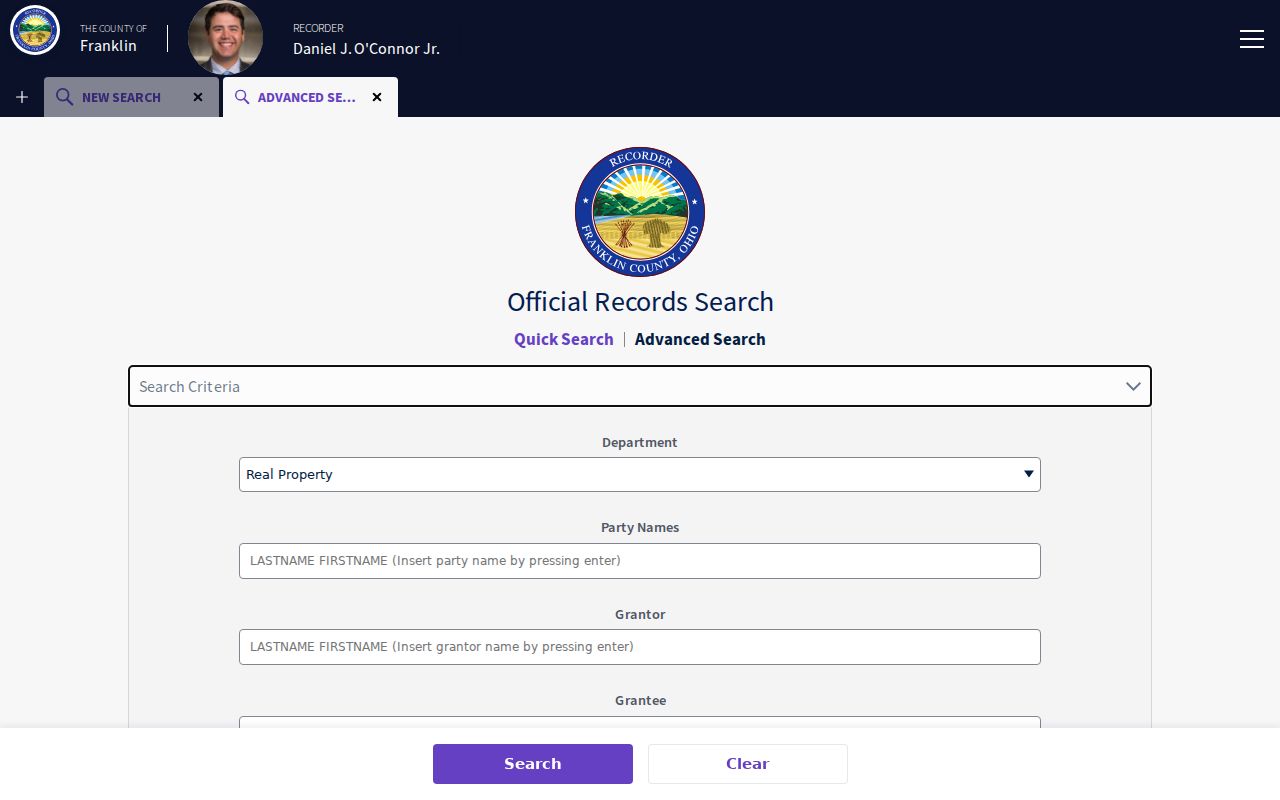
Use the original indexed document and its citation as the evidence point. An index result helps locate a transaction but is not a title opinion or proof of continuous occupancy.
Jackson Township Previous Residents Cross 1914
The Recorder's historical guide draws a firm research boundary. Its deed indexing begins January 2, 1914, while the historic deed route covers 1804–1913. Modern Cloud Search can use party names, recorded dates, document types, book or volume and page, legal-description fields, and OCR text. Once a Jackson Township chain enters the earlier period, do not expect a modern address search to solve it. Switch to the legacy deed-index path and use the property identifiers already gathered.
The methods are different because the records are different. Modern searching can begin with a party or legal phrase. The earlier route starts with the correct grantor or grantee index, alphabetic surname segment, and handwritten index page. A volume and page citation then bridges from the index page to the underlying transaction. Preserve both the citation and the role shown beside the name.
INSIDER TIP. Recorder Cloud Search distinguishes index-only searching from OCR phrase searching. Use quotation marks for an exact phrase and the documented wildcard tools when a name or legal description has a variant.
Jackson Township Past Resident Indexes
For the 1804–1913 period, the Recorder's own historical-search procedure calls for selecting Deed Indexes 1804–1913, narrowing by time and grantor or grantee, and finding the surname in the handwritten index. Note that page number, return to the results, and use the volume and page cited there to reach the transaction. This is why an old Jackson Township deed chain can remain traceable even where a name or street address will not behave like a current database search.
The recorded entry may show a party name, role, year, handwritten index page, and deed-book volume and page. A family relationship may appear in a transaction, but it must be read from the document itself. A historic index is a route to evidence, not a complete list of past residents or a substitute for checking the parcel and legal description.
The Recorder's historic deed-index guide illustrates this handwritten-index and volume/page process.
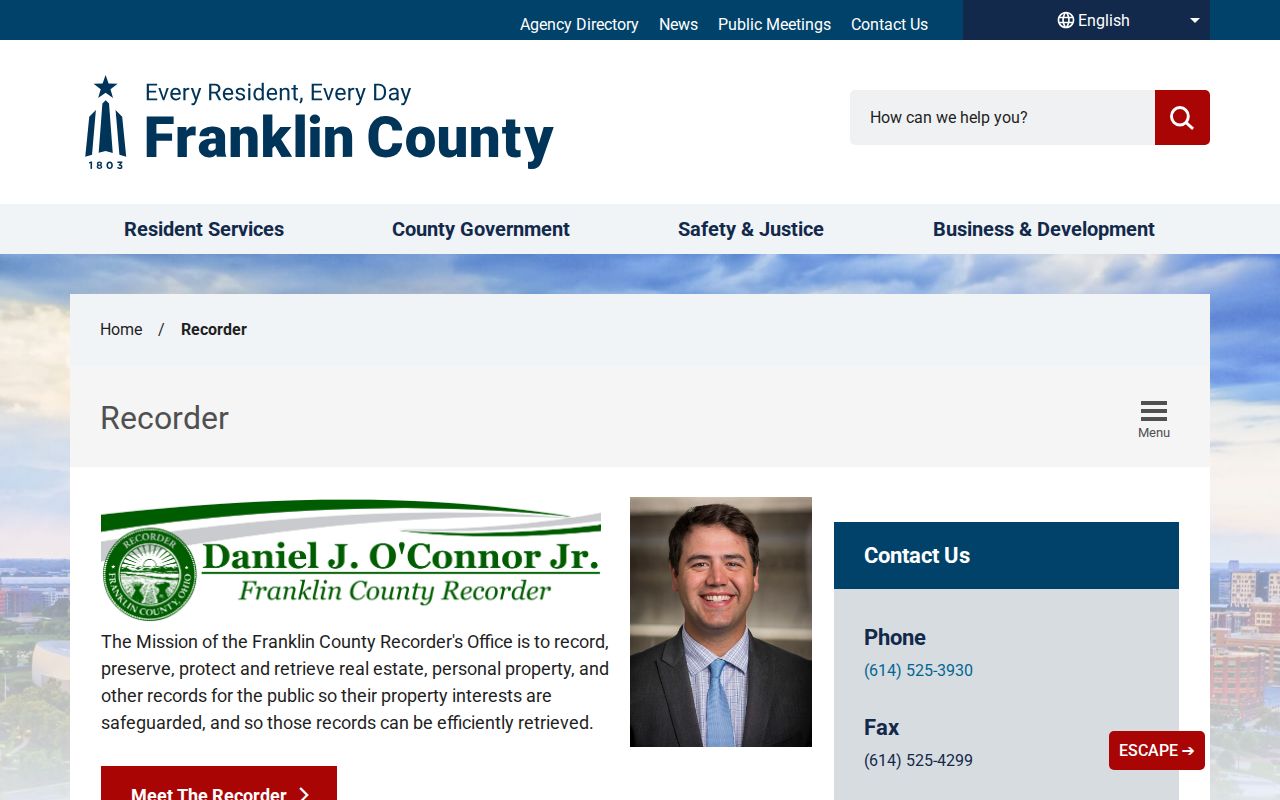
Take a clear note of the surname spelling, party role, index-page range, and book/page reference before moving to the next deed in the chain.
Franklin County's 1879 Deed Gap
Some pre-1914 Recorder material was destroyed in the 1879 fire, although the Recorder says most records were reconstructed. That county history matters when a past-resident trail develops a gap. It does not mean every missing result proves a move, sale, or absence. Spelling, incomplete indexing, older legal-description practice, and reconstruction history can all require a second check.
Bring a legal description, surname variants, known index page, and volume/page citation to the Recorder if the online path stops short. The Recorder counter is at 373 S. High Street, 18th Floor, and the documented public hours are weekdays from 8 AM to 4 PM. The Document Imaging Center is also part of the county's preservation system for paper, microfilm, and electronic images. Its 2024 report recorded more than 21 million image conversions and over 5.7 million old Clerk microfiche images converted and indexed.
Note: The 1879 loss and reconstruction caveat applies to Franklin County Recorder records, not to every Jackson Township record series.
Jackson Township Past Households by Date
Ownership is only one layer of who lived here before. Columbus Metropolitan Library's house-history guide says its Main Library shelf begins in 1841 and that street-address sections begin in 1911. Those volumes generally list residents, addresses, and often occupations, but early city directories are most useful within historic Columbus limits. Check the specific volume before treating a Jackson Township or Grove City-area address as included or absent. The digitized collection is in progress, not a complete run.
The strongest dated regional checks are more modest. CML documents a September 1936 Franklin County phone book with Grove City and Galloway, and a 1944 telephone directory that includes Grove City, Urbancrest, Valleyview, and Lockbourne. Phone books identify subscribers, not every occupant. The Grove City Record archive, which covers 1901–2011, can add notices, obituaries, and civic or property context. Its reported 63,441 pages are a searchable newspaper collection, not a townshipwide residence roll.
Build the household timeline only after confirming that the directory or telephone book actually covers the Jackson Township or Grove City-area address.
- Set the property period with a parcel record, deed date, legal description, and document citation.
- Check a directory or telephone-book year that documents the relevant area, then record whether the result is an occupant or subscriber clue.
- Pair that period with an available federal census release, treating the schedule as a dated household snapshot rather than a continuous address record.
- Use an obituary, Probate matter, or newspaper notice to test a later life event, then return to recorded deeds for a legal transition.
Federal schedules become public after the 72-year release rule. The historical collections themselves are described in the Jackson Township city directories collection. Franklin County Probate Court supplies useful family-history brackets: marriage records run from 1803 forward, the online marriage index begins in 1995, and estate, guardianship, and name-change records run from 1898. Probate also holds local birth and death records for 1867–1908. Those records can confirm a family event or estate transition, but not a continuing address on their own.
Lawful house history. Use Jackson Township past-resident records for family history, estate questions, property research, or personal curiosity. Do not use dated records to track, threaten, or harass a living person.
Jackson Township Past Residents and Old Roads
A bare street number can fail across decades. The same parcel may appear with a changed suffix, road name, rural mailing convention, or postal city. Keep the parcel ID, legal description, subdivision or lot, Recorder document number, and volume/page with every address note. Jackson Township's Grove City mailing geography can otherwise send a search toward the wrong city title or a newer address form.
CML's house-history materials name Caldwell 1872, Baist 1899, 1910 and 1920, Modie & Kilmer 1910, a 1937 Franklin Survey Company plat book, and Columbus Sanborn editions. Those are library holdings and references, not assurance that any particular sheet covers Jackson Township. For a road relocation, old plat, annexation, or numbering problem, Franklin County Engineer records management has historical maps from 1842 along with road record books, plats, private surveys, right-of-way plans, field books, drainage files, aerials, and address-assignment material for unincorporated areas.
Ask for a named road, section, plan, subdivision, or approximate date. That focused request can test address continuity without guessing that a modern online map contains every historic road name.
Jackson Township Historic Record Request Path
Jackson Township has zoning, planning, meeting, road, and fire-prevention records that may date a known property event. It does not offer a verified, full online historic permit archive searchable by address. A useful request names the address or parcel, approximate decade, and record type, such as a permit, variance, demolition, driveway, drainage, road, or fire-system record. That asks for an existing file rather than a list of former households.
Contact the Township Administrator at 614-991-6881 or twpadministrator@jacksontwp.org, or use the Township public-information channel. The Zoning Department accepts completed applications at zoning@jacksontwp.org and lists the same 614-991-6881 contact for questions. Ohio's Public Records Act, ORC 149.43, allows prompt inspection during regular business hours and copies within a reasonable time. An office can ask for clarification, but the right does not depend on a written request, identity disclosure, or a stated purpose.
A construction, demolition, variance, or road record may help date activity at a parcel. It does not establish who occupied the address. When the question concerns recorded ownership, return to the Auditor and Recorder trail.
Jackson Township Past-Resident Record Limits
Past-resident work ends with a source note, not a claim about a living household. Deeds identify recorded transaction parties. Directories and telephone books provide dated entries. Census and Probate materials have their own dates and access rules. Compare each observation with the parcel, legal description, and time period before adding it to a house history.
For a current recorded-document concern, the Recorder's free Property Alert can monitor a name, keyword, or a document/property description after registration. It sends notice of matching real-property filings, but the Recorder expressly says it does not guarantee fraud prevention. It is a current safety tool, not a way to reconstruct prior ownership or occupancy.
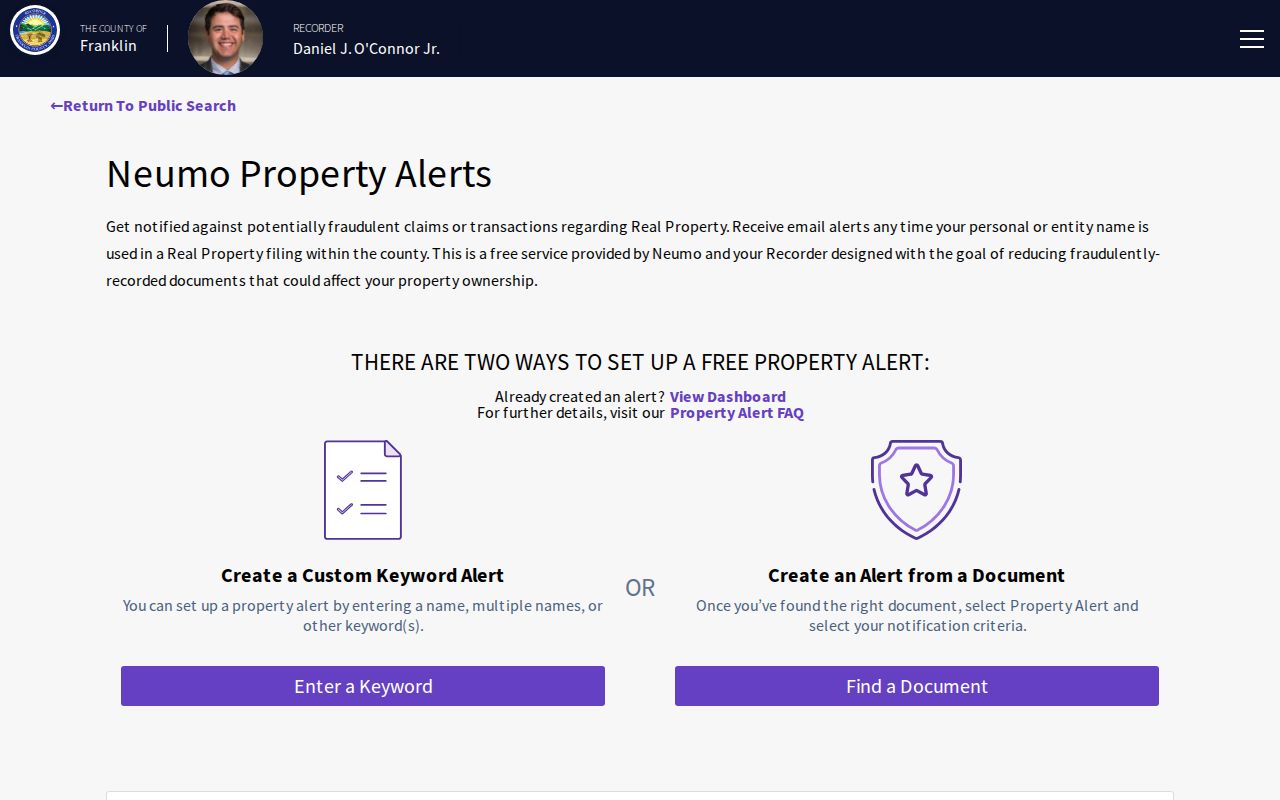
Use the alert as a prompt to examine the recorded document and contact Recorder staff when a filing needs verification. It does not replace the backward deed chain or the separate household research trail.