
Jackson Township City Directory Collections
Jackson Township has no verified standalone, continuous city-directory run. The useful shelf is regional: Columbus Metropolitan Library, Franklin County Recorder material, and Grove City-area collections. Columbus Metropolitan Library, commonly called CML, is the main starting point. Its Main Library holds Columbus city directories beginning in 1841. The volumes are generally annual and alphabetical, often giving an occupant's address and occupation. Those are strong research leads, not a promise that every named Jackson Township household appears in every year.
| Collection | Verified years | Where held | Access |
|---|---|---|---|
| CML Columbus city-directory shelf | Begins 1841; street-address sections begin 1911 | CML Main Library, 96 S. Grant Ave. | Use the house-history collection guidance and check individual volumes |
| CML digitized City Directory Collection | Selection from the 1840s forward; still in progress | CML Digital Collections | Online selection; 77 catalog records were observed during research |
| Columbus City Directory, G.J. Brand & Co. | 1881; 504 pages | CML Digital Collections | Documented Franklin County township and emerging-suburb candidate |
| R.L. Polk & Co.'s Columbus City Directory | 1889-90 | CML Digital Collections | Late nineteenth-century publisher and year example |
| Franklin County Phone Book | September 1936 | CML Digital Collections | Alphabetical subscriber list that includes Grove City and Galloway |
| Grove City Record | 1901-2011 | Southwest Public Libraries digital archive | Searchable newspaper context; the archive reports 63,441 pages |
The CML digitized City Directory Collection is the online entry point for a selected group of directories and early Franklin County telephone books.
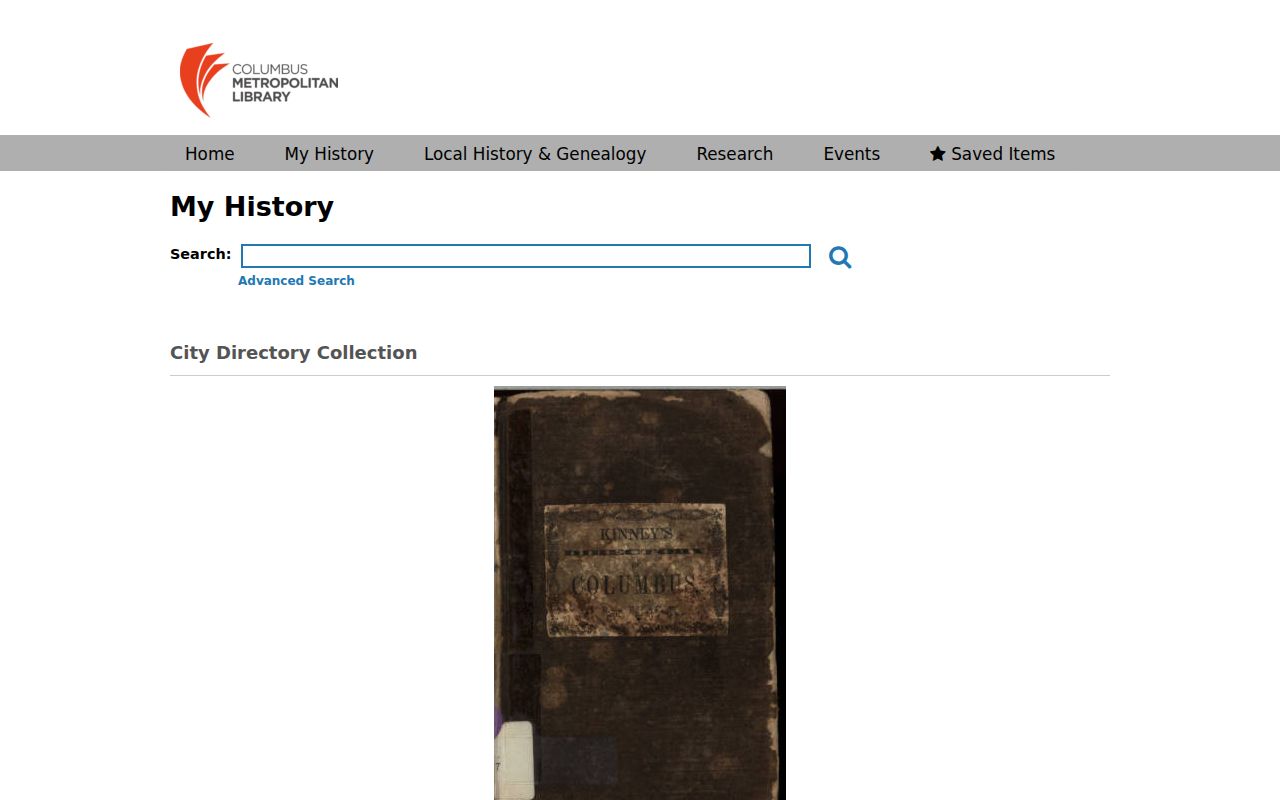
The catalog is useful for locating a specific title or year. Its in-progress status means a missing digital item should not be treated as proof that no printed volume exists.
Jackson Township Directory Coverage Checks
Columbus titles need a volume-by-volume check before they are used for Jackson Township. CML warns that early city directories are particularly useful within historic Columbus corporate limits. A Grove City mailing place or a present-day township address does not establish that a given Columbus volume included the same area. The 1881 directory is the strongest documented candidate because its CML metadata says it covers Columbus and Franklin County, including townships and emerging suburbs. That still calls for a search of the actual volume and a comparison with the address or place name at the time.
Street sections can be valuable when an address is known, but CML dates the beginning of those sections to 1911. Before that, alphabetical entries and other county records may be the better route. Postal and civil geography can also diverge. Jackson Township administration uses a Grove City postal address, while older property trails may be tied to township, county, or historic road descriptions. Keep the title, year, place wording, and exact page with every finding.
CML's house-history guide documents the library shelf, street-section date, and the caution about occupants versus owners.
Use the guide with a map, plat, or deed description when a street name or numbering pattern looks different from current usage.
Note: A collection title can identify a research path without confirming coverage for one Jackson Township address in one particular year.
Reading a Jackson Township City Directory Entry
A scanned directory entry is best read as a dated transcription clue. CML's inspected 1889 directory page showed a surname and given name, a marital-status descriptor such as wid, an occupation, an abbreviated number-and-street address, and sometimes a business association. OCR can be imperfect. Read the image rather than silently accepting the machine text, and do not expand an abbreviation into a relationship, ownership claim, or modern street name without another source.
| Entry field | How to read it |
|---|---|
| Surname and given name | The indexed identity as printed, useful for spelling variants. |
| Marital descriptor | A notation such as wid, recorded as a status clue rather than proof of a date. |
| Occupation | A contemporaneous descriptive field that can help distinguish same-name entries. |
| Abbreviated address | A number and street form that should be reconciled to a map, plat, or deed description. |
| Business association | Appears in some entries and can provide a separate historical search term. |
- Directory entry
- A published listing that identifies an occupant or other named person for a particular edition, not necessarily the property owner.
- Street-address section
- The address-ordered part of a directory. CML says these sections begin in its Columbus directory shelf in 1911.
- OCR
- Machine-read text made from a scan. It helps locate an entry but can misread letters, numbers, and abbreviations.
- Legal description
- The formal lot, subdivision, or other property wording that can bridge a directory address to a recorded land document.
The 1881 Columbus and Franklin County directory is the documented township-inclusive candidate, and it is a 504-page volume.
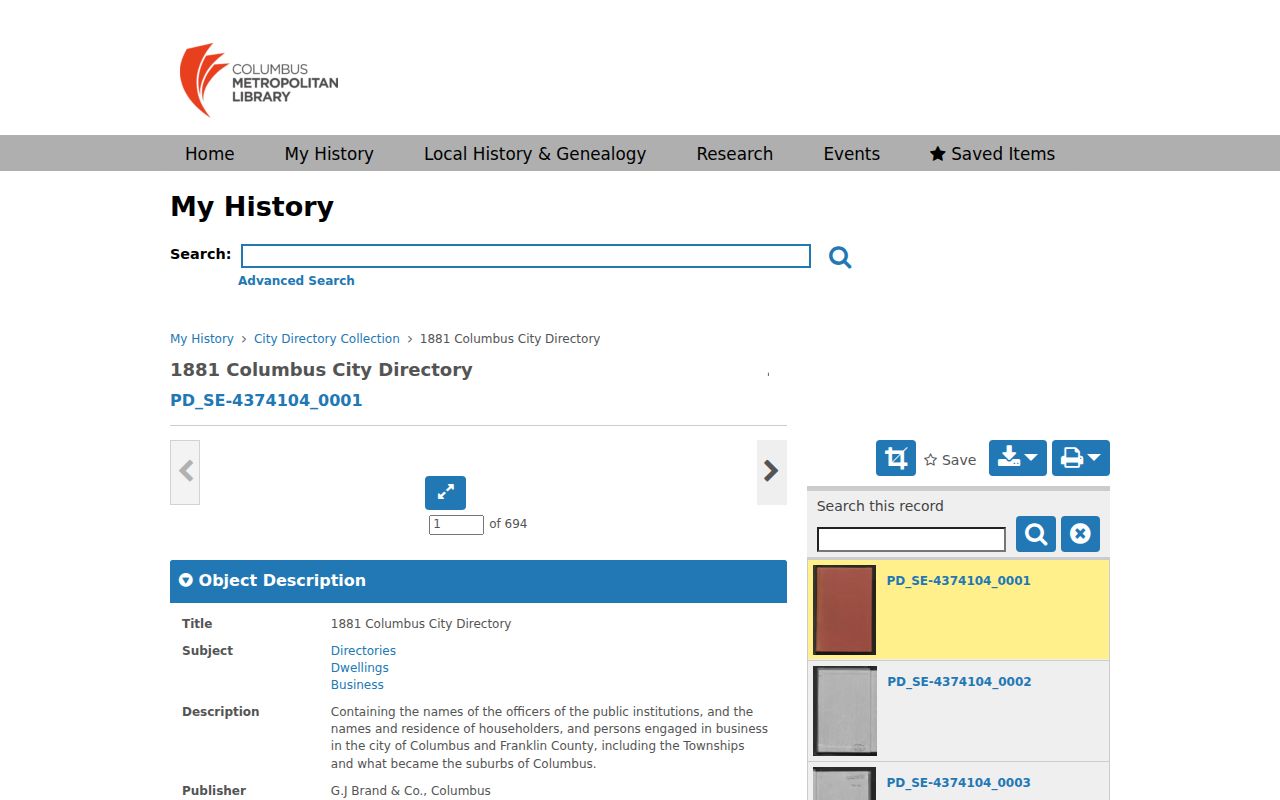
Its stated Franklin County coverage makes it a good first volume to test, while the printed entry itself remains the evidence for any particular name or address.
Jackson Township Index Comparison
City directories and Recorder indexes answer different historical questions. A CML directory may place an occupant at an abbreviated address, but it does not establish ownership. The Franklin County historic deed indexes, by contrast, cover 1804 through 1913 and follow recorded property transactions. The Recorder's documented historic method starts with the first letters of a surname, then the correct handwritten index page, and finally the volume and page of the recorded instrument.
A grantee is the party receiving an interest in a recorded instrument. A grantor is the party conveying it. The Recorder's worked 1859 example shows that a historic deed/index entry can hold a party name, role, year, handwritten-page reference, deed-book volume, and page. A later instrument may reveal a family relationship. That is a more defensible property trail than inventing a Jackson Township directory series that has not been verified.
Index comparison. Use a city-directory listing to locate a dated occupant lead, then use the Recorder's name, legal-description, and book-page path for the property record.
The Recorder's historic-search brochure is the source for the handwritten-index workflow and its volume/page bridge.
Trace Jackson Township Directory Households
Follow a household as a sequence of dated evidence, not as an uninterrupted residence claim. Begin with the most stable property identifiers. A modern Auditor parcel record separates the site address, owner mailing/contact address, parcel ID, legal description, and subdivision or lot wording. Keep those fields separate. A directory or phone book may then offer a name, spelling, address form, or date to test against land and family-history records.
- Capture the parcel ID, site address, legal description, and subdivision or lot wording from a modern property record. Do not convert a mailing field into a household list.
- Search Recorder Cloud Search by the party name or legal description, and preserve the document number and recorded date with the deed or plat trail.
- At the historic boundary, use the 1804-1913 handwritten grantor/grantee index, recording the surname segment, page, role, volume, and page.
- Match the property period to a CML or SPL directory, telephone book, newspaper, yearbook, census release, or Probate index that actually covers the period.
- Use an obituary, probate or heir filing, cemetery source, and recorded deed together to close a deceased person's documented trail.
Street numbers can change, roads can acquire a new name or suffix, and an old rural address can use Columbus or Grove City wording. A parcel ID, legal description, subdivision lot, Recorder volume/page, or document number is often a better bridge than a bare street search. Federal census schedules are public under the 72-year release rule, so a census result is a dated household snapshot, not a continuous address history.
Note: Keep a directory page number beside every parcel, deed, census, or Probate citation so a later researcher can test the connection.
Jackson Township Directory Family History
Grove City-area collections add local context when a city-directory volume is thin. The Grove City Record archive runs from 1901 through 2011 and reports 63,441 pages. It can be searched for names, obituaries, property or civic notices, and organizations. CML also identifies a September 1936 Franklin County Phone Book that includes Grove City and Galloway, plus a 1944 telephone directory with Grove City, Urbancrest, Valleyview, Lockbourne, and other communities. Telephone books are subscriber lists, not a census.
Southwest Public Libraries' From Attics to Archives project is curated with Grove City Library information services, the Southwest Franklin County Historical Society, Grove City, and local partners. Only part is online. Its research contact is reference@swpl.org or 614-875-6716 ext. 503. CML's digitized yearbooks include selected years from 1924 through 1955 with gaps, including a 1925 Grove City/Jackson Township High School item. These sources support family history and classmate research, but they are not current resident rolls.
The Southwest Franklin County Historical Society serves a regional area that includes Grove City, Jackson, Pleasant, Prairie, and Franklin townships.
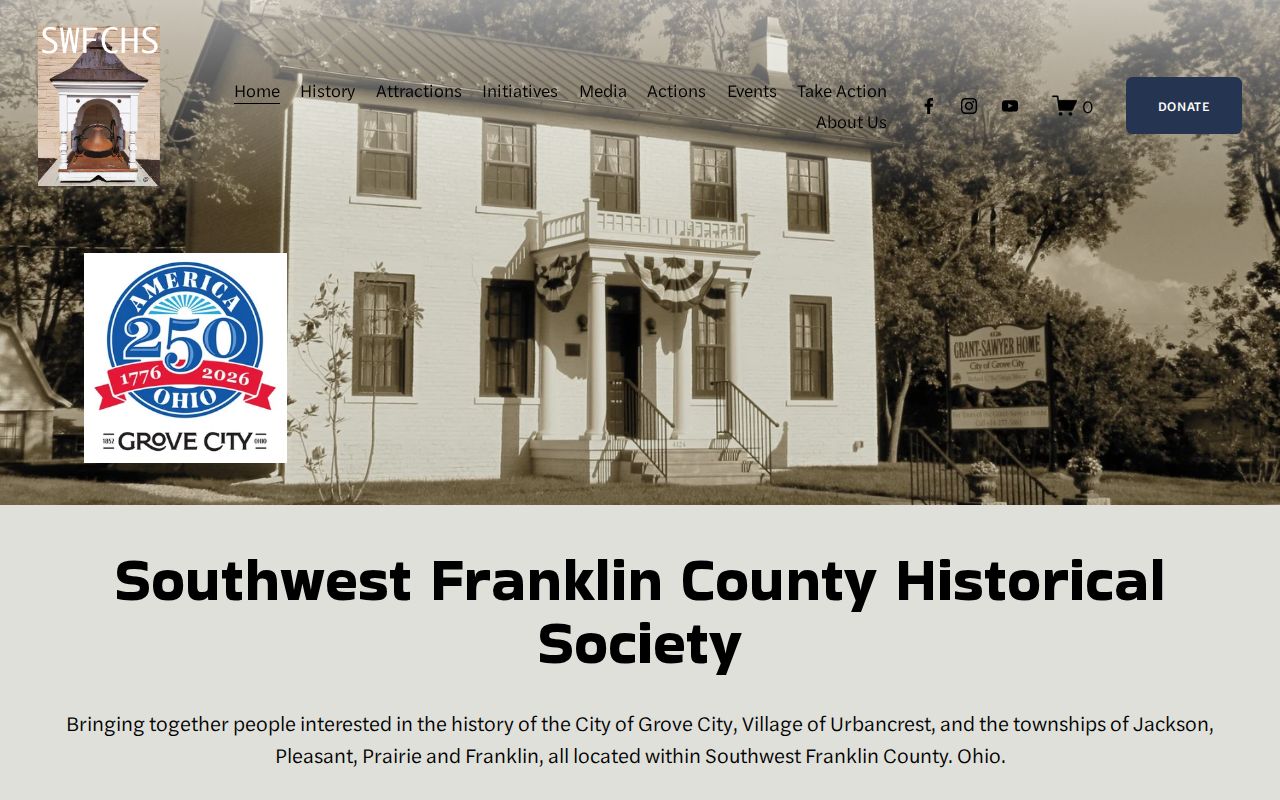
Its local-history scope makes it a useful partner for place names and family context that a countywide directory title may not spell out.
Jackson Township Records Timeline
Dates sort the right custodian from the wrong one. Jackson Township was founded in 1815, but the Franklin County land and Probate trail begins earlier. CML's directory shelf begins later still, and its digitized collection is incomplete. The timeline keeps those layers distinct instead of treating an online catalog as a complete historical record.
| Date or span | Collection milestone | Why it matters |
|---|---|---|
| 1803 | Franklin County formed | County-level legal and Probate context begins before the Township's founding. |
| 1804-1913 | Recorder historic deed-index span | Handwritten grantor/grantee index and volume/page research route. |
| 1815 | Jackson Township founded | Local government history, distinct from county record custody. |
| 1841 | CML directory shelf begins | Earliest documented Columbus directory holding, subject to coverage checks. |
| 1901-2011 | Grove City Record archive | Longer local newspaper layer for notices and family-history context. |
| 1911 | CML street-address sections begin | Documented point when the shelf adds an address-ordered directory feature. |
| 2024 | Document Imaging Center preservation report | More than 21 million image conversions and 5.7 million-plus old Clerk microfiche images converted or indexed. |
The Recorder-administered Document Imaging Center converts paper and electronic documents to microfilm and computer systems, and scans microfiche and microfilm into electronic images. Its preservation work explains why useful county material can exist in more than one format. It does not mean every record can be browsed from one public screen. A counter or archival inquiry may remain the correct next step.
Note: Record dates identify the collection to try first, while the title, page, document number, and custodian establish what the result actually proves.
Franklin County Fire Reconstruction
The 1879 fire is a key warning for historic property research. The Recorder says some pre-1914 records were destroyed, although most were reconstructed. A missing deed-index result may reflect preservation history, indexing, spelling, or an older legal-description practice. It is not proof that a family left Jackson Township or that an address had no earlier history.
When a sequence breaks, return to the Recorder with the surname variant, handwritten index-page reference, legal description, and any available volume/page citation. The historic-search instructions specifically support that approach. Compare the reconstructed land trail with the appropriately dated directory, newspaper, Probate, and census evidence. Each record adds a bounded point, not a claim of continuous occupancy.